

Stop Guessing. Start Spraying Right.
Choosing between an electrical airless spray machine and a pneumatic (air-operated) airless machine isn’t just a technical decision—it’s a critical business decision that affects your project timeline, safety compliance, finish quality, and bottom line.
At Shree Bissa Engineering (SBECOAT), with over a decade of experience as India’s leading industrial painting equipment manufacturer, we’ve helped thousands of contractors, fabricators, and plant managers make this exact choice. This comprehensive guide distills our field expertise into actionable insights you can use today.
Executive Summary: Which Machine Wins for Your Application?
| Your Application | Recommended Type | Key Reason |
|---|---|---|
| Structural Steel Painting | ✅ Electrical | Cost-effective, portable, perfect for site work |
| Factory Maintenance Painting | ✅ Electrical | Easy operation, minimal setup |
| Oil & Gas / Refinery Projects | ✅ Pneumatic | Hazardous area safety, no spark risk |
| Shipbuilding & Marine | ✅ Pneumatic | Continuous operation, handles thick coatings |
| Construction Contracting | ✅ Electrical | Mobility, lower operating cost |
| Chemical Plant Maintenance | ✅ Pneumatic | Explosion-proof operation |
| Heavy Epoxy/Intumescent Coating | ✅ Pneumatic | Superior high-viscosity handling |
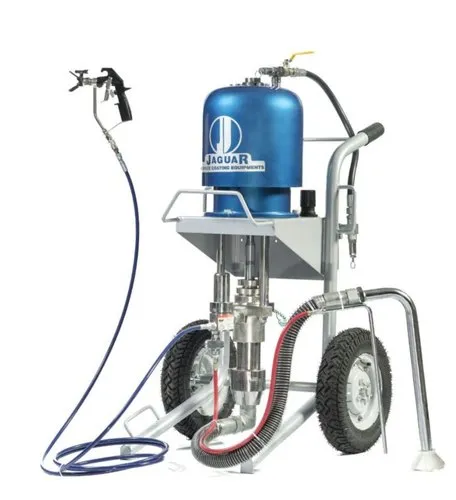
Chapter 1: Understanding the Core Technology
How Airless Spraying Works (Both Types)
Both electrical and pneumatic airless machines operate on the same fundamental principle: hydraulic pressure.
- A pump creates extremely high pressure (typically 2,000-3,000 PSI)
- Paint is forced through a small orifice in the spray gun tip
- The paint atomizes into fine particles without compressed air
- Result: Faster application, better penetration, less overspray
The key difference lies in what powers that pump.
Chapter 2: Electrical Airless Spray Machines – The Contractor’s Choice
Technical Specifications & Capabilities
- Power Source: 220V AC, Single phase (generally)
- Flow Rate: 1.5 – 3.5 GPM (Gallons Per Minute)
- Pressure Range: 500 – 3,300 PSI
- Max Viscosity: Up to 5,000 cPs
- Typical Applications: Primers, enamels, PU coatings, acrylics, textures
Who Should Choose Electrical? (Ideal User Profile)
✔ Construction Painting Contractors
✔ Industrial Maintenance Teams
✔ Fabrication Shop Owners
✔ Infrastructure Project Managers
✔ Paint Applicators needing mobility
Real-World Case Study: Bridge Painting Project
Challenge: Paint 25,000 sq.m of structural steel with epoxy primer and polyurethane topcoat within 45 days.
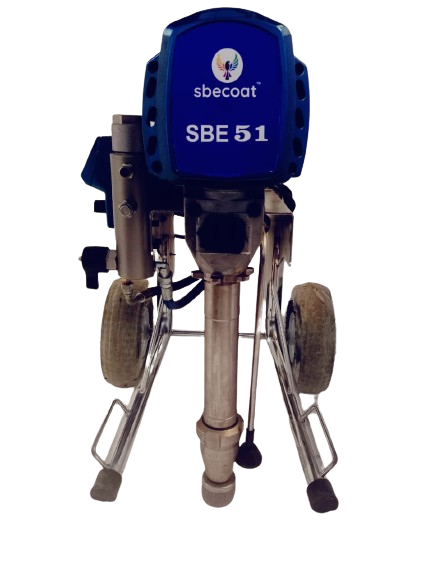
Solution: SBECOAT recommended 2× Electrical Airless Spray Pumps (3.0 GPM, 3000 PSI) with:
- 100m reinforced hose lines
- Reversible tips for clog prevention
- Mobile generator backup
Result: Project completed in 38 days with 40% less paint consumption compared to conventional spraying.
Chapter 3: Pneumatic Airless Machines – The Industrial Powerhouse
Technical Specifications & Capabilities
- Air Requirement: 20 – 60 CFM at 80-100 PSI
- Air-to-Paint Ratio: Typically 1:1 to 2:1
- Pressure Range: Up to 5,000 PSI (specialized models)
- Max Viscosity: Up to 10,000+ cPs
- Hazardous Area Ratings: ATEX, IECEx Zone 1/2 certified options
Who Should Choose Pneumatic? (Non-Negotiable Applications)
⚠️ Mandatory Choice When:
- Working in flammable/explosive atmospheres (Zone 1, Zone 2)
- Spraying intumescent fireproofing coatings
- Applying 100% solids epoxy in tank linings
- 24/7 production line operations
- Offshore platform maintenance
Safety First: Why Pneumatic Wins in Hazardous Zones
Electrical equipment in explosive atmospheres requires:
- Intrinsically safe design
- Expensive certification (ATEX, IECEx)
- Regular compliance checks
Pneumatic machines eliminate this entirely. No electricity means no spark risk, making them inherently safe for:
- Oil refineries
- Chemical storage areas
- Fuel tank interiors
- Gas pipelines
Chapter 4: Head-to-Head Comparison Table
| Parameter | Electrical Airless | Pneumatic Airless | Winner For |
|---|---|---|---|
| Initial Investment | ₹65K – ₹1.5L | ₹95k – ₹1.4L + Compressor | Electrical |
| Operating Cost/Hour | ₹50-100 (electricity) | ₹150-300 (compressed air) | Electrical |
| Portability | Excellent (wheel cart) | Good (needs air line) | Electrical |
| Hazardous Area Use | Not recommended | Perfect | Pneumatic |
| Continuous Operation | 4-6 hours recommended | 24/7 capable | Pneumatic |
| Viscosity Handling | Good (up to 5K cPs) | Excellent (10K+ cPs) | Pneumatic |
| Maintenance Complexity | Medium (electrical parts) | Simple (air motor) | Pneumatic |
| Setup Time | 15-20 minutes | 30-45 minutes (air setup) | Electrical |
| Typical Lifespan | 3-5 years | 7-10+ years | Pneumatic |
pneumatic has higher initial cost, its value in hazardous areas is irreplaceable. For non-hazardous work, electrical provides 20-50% lower total cost.
Chapter 5: Common Mistakes to Avoid
Mistake #1: Using Electrical in Zone 1 Areas
Risk: Catastrophic explosion, legal liability, criminal charges
Solution: Always conduct area classification assessment before equipment selection
Mistake #2: Undersizing Air Supply for Pneumatic
Consequence: Poor atomization, uneven coating, pump damage
SBECOAT Rule: Air supply CFM should be 1.5× machine requirement
Mistake #3: Ignoring Viscosity Requirements
Example: Trying to spray 8,000 cPs intumescent with standard electrical pump
Result: Pump failure, project delays
Fix: Match pump type to coating data sheet specifications
Chapter 6: SBECOAT’s Expert Selection Framework
Our 5-Point Decision Matrix
Answer these questions to get your perfect match:
- Location Safety: Is it a hazardous/classified area?
→ Yes = Pneumatic | No = Proceed to Q2 - Coating Type: Viscosity above 5,000 cPs or 100% solids?
→ Yes = Pneumatic | No = Proceed to Q3 - Operation Time: Continuous 8+ hour daily operation?
→ Yes = Pneumatic | No = Proceed to Q4 - Budget Priority: Capital cost sensitivity?
→ High = Electrical | Low = Proceed to Q5 - Future Flexibility: Multiple site vs fixed location?
→ Multiple sites = Electrical | Fixed plant = Pneumatic
Chapter 7: Industry-Specific Recommendations
For Fabrication Shops & OEMs
Recommended: Electrical Airless
Why: Multiple coating types, non-hazardous environment, cost sensitivity
SBECOAT Package: SBE 25 E-AIRLESS
For Oil & Gas Turnaround Contractors
Recommended: Pneumatic Airless
Why: Hazardous zones, thick epoxies, continuous operation
SBECOAT Package: PAS-4000 + compressor + explosion-proof lighting
For Infrastructure Companies
Recommended: Electrical Airless
Why: Site mobility, various substrates, contractor preference
Chapter 8: Frequently Asked Questions
Q1: Can I convert an electrical machine to pneumatic?
A: No. The internal mechanisms are fundamentally different. It’s more cost-effective to purchase the correct type initially.
Q2: What about battery-powered airless sprayers?
A: These are for light-duty/decorative applications only. For industrial coatings, you need the consistent power of electric or pneumatic.
Q3: How do I maintain my airless spray pump?
A:
- Daily: Filter cleaning, tip inspection
- Weekly: Packing adjustment, fluid section check
- Monthly: Motor/air motor inspection
- SBECOAT offers AMC packages starting at ₹15,000/year
Q4: Does SBECOAT provide onsite training?
A: Yes. Every machine purchase includes:
- 2-hour operator training
- Maintenance workshop
- Safety protocol demonstration
- Troubleshooting guide
Chapter 9: Next Steps – Get Your Personalized Solution
Why Choose SBECOAT as Your Partner?
✓ 15+ Years industrial painting expertise
✓ Complete solutions (machine + compressor + accessories)
✓ After-sales network across ALL India
✓ Project consultation at no extra cost
Get a Custom Recommendation
Option 1: Complete our Project Assessment Form
Option 2: Schedule a 15-Minute Technical Call with our experts
Option 3: Visit our Demo Facility in Gandhidham, Gujarat Location (Live testing available)
Final Verdict
Choose Electrical Airless When:
- Working in non-hazardous areas
- Budget and mobility are priorities
- Coating viscosity is below 5,000 cPs
- Operation is intermittent (not 24/7)
Choose Pneumatic Airless When:
- Safety compliance is non-negotiable (hazardous zones)
- Spraying high-viscosity or specialty coatings
- Continuous production operation
- Long-term durability outweighs initial cost
📞 Ready to Transform Your Painting Operations?
Contact SBECOAT Experts Today:
- Call: +91-84870-85228
- Email: sbecoat.india@gmail.com
- WhatsApp: +91-84870-85228
“Don’t just buy equipment—invest in the right productivity solution.”
– Shree Bissa Engineering (SBECOAT) Team